
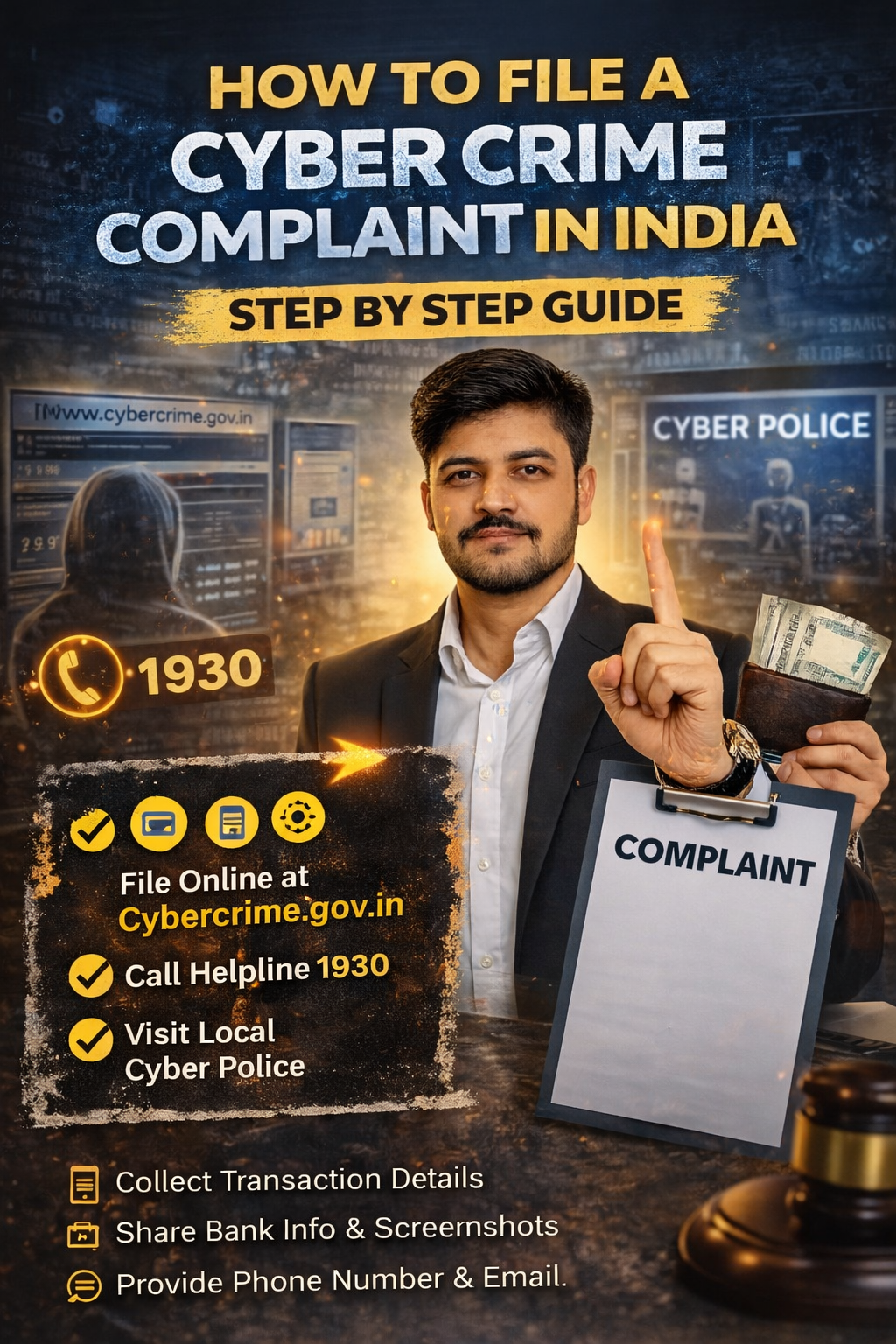
If you have been scammed online, lost money in a digital fraud, received threatening messages, had your identity stolen, or been a victim of any other cyber crime, filing a complaint is the single most important step you can take. A properly filed complaint initiates the legal machinery, enables the police to trace the accused, freeze accounts, and recover funds, and creates the documentary record you need if the matter goes to court.
Yet many victims in India either do not file a complaint at all—because they do not know how—or file one that is so incomplete that it gets lost in the system. This guide walks you through every step of the process, from the initial phone call to the 1930 helpline to filing online, visiting the cyber police station, and following up effectively. It also covers the evidence you should collect, the common mistakes to avoid, and when it makes sense to engage a cyber crime lawyer.
Why Filing a Cyber Crime Complaint Matters
Many victims of online fraud hesitate to file a complaint, assuming the amount is too small, the police will not help, or the fraudster will never be caught. These assumptions, while understandable, are often wrong. Here is why filing a complaint matters, regardless of the amount involved.
- Triggers the investigation: Without a formal complaint, the police have no basis to investigate. No complaint means no case, no tracing of funds, and no chance of recovery or prosecution
- Enables account freezing: When a complaint is registered—especially through the 1930 helpline—the Indian Cyber Crime Coordination Centre (I4C) can issue quick freeze requests to banks, preventing the accused from withdrawing the defrauded funds
- Creates a legal record: The complaint becomes part of the official record. If the matter proceeds to court, the complaint date, details, and evidence form the foundation of the prosecution case. If you need to claim insurance or approach the banking ombudsman, a complaint reference is typically required
- Helps identify patterns: Cyber criminals typically operate at scale—defrauding dozens or hundreds of victims. Each complaint adds to the data that helps police identify the network, trace the operators, and build a stronger case for prosecution
- Protects you legally: In some cases—particularly involving bank account freezes—you may need to demonstrate that you were a victim, not a participant. Having a complaint on record protects your position
In short, filing a complaint is not optional. It is the first and most critical step in the process of seeking justice and recovery.
Step 1 — Call the National Cyber Crime Helpline 1930
The national cyber crime helpline number 1930 is your first point of contact when you discover you have been defrauded. This toll-free number is operated by the Indian Cyber Crime Coordination Centre (I4C) under the Ministry of Home Affairs, and it is available 24 hours a day, 7 days a week. The 1930 helpline is specifically designed for financial cyber crimes—situations where money has been lost through UPI fraud, phishing, fake investment platforms, online shopping scams, or similar digital fraud.
When you call 1930, here is what to expect and how to make the most of the call:
- Be ready with details: Before calling, have your bank account number, UPI transaction IDs, the amount lost, the date and time of the transaction, the beneficiary UPI ID or account number (if known), and your registered mobile number ready. The operator will ask for these details to register the complaint
- Describe the fraud clearly: Explain what happened in chronological order. Start with how you were contacted, what you were told, what action you took (e.g., shared OTP, approved a payment request, transferred money), and when you realised it was a fraud
- Obtain a ticket or reference number: The operator will register your complaint and provide a reference number. Write this down and keep it safe—you will need it for follow-up and for any further submissions
- Quick freeze mechanism: One of the key advantages of calling 1930 is that the I4C system can immediately issue a freeze request to the bank holding the accused's account. If the money has not yet been withdrawn, this can prevent the fraudster from accessing it. This is why calling as soon as possible—ideally within the first hour—is so critical
Step 2 — File Online at cybercrime.gov.in
After calling 1930, the next step is to file a formal online complaint on the National Cyber Crime Reporting Portal at cybercrime.gov.in. This portal is the official government platform for registering cyber crime complaints online and is linked to state police cyber crime cells across India. Here is a detailed walkthrough of the process:
- Visit the portal: Go to cybercrime.gov.in and click on "File a Complaint." You will be asked to register with your mobile number and email. OTP verification is required
- Select complaint category: The portal classifies complaints into three main categories: (1) Women/Child Related Crime, (2) Financial Fraud, and (3) Other Cyber Crime. For most fraud cases—UPI fraud, phishing, investment scams, job scams—select "Financial Fraud." For identity theft, hacking, or cyberstalking, select "Other Cyber Crime"
- Fill in personal details: Enter your full name, address, state, district, and contact information. Ensure these details match your bank records and identity documents, as inconsistencies can delay investigation
- Provide incident details: Describe the incident in detail. Include the date and time of the fraud, how the fraudster contacted you (WhatsApp, phone call, email, social media, website), what they said or did, what payment method was used (UPI, net banking, debit card, wallet), the exact amount lost, and the transaction ID or reference number. Be specific—a clear, factual narrative is far more useful than a vague description
- Enter suspect information: If you have any details about the suspect—phone number, UPI ID, bank account number, email address, social media profile link, website URL—enter them. Even partial information helps investigators
- Upload evidence: The portal allows you to upload supporting documents. Upload screenshots of the transaction, chat conversations with the fraudster, bank statements showing the debit, payment app screenshots, and any other relevant evidence. Ensure files are clearly named and in readable format (JPG, PNG, or PDF)
- Submit and save acknowledgement: After reviewing your complaint, submit it. You will receive a complaint acknowledgement number. Save this, take a screenshot of the confirmation page, and note the date of submission. This acknowledgement is your proof of filing
After filing, the complaint is forwarded to the relevant state cyber crime cell based on your location or the location of the accused. You can track the status of your complaint on the portal using your acknowledgement number. The portal also allows you to add supplementary information or evidence after the initial filing if needed.
Step 3 — Visit Your Local Cyber Police Station
While the online complaint through 1930 and cybercrime.gov.in is essential, there are situations where visiting the police station in person is necessary or beneficial. You should visit the cyber police station if the amount involved is significant (typically above Rs 50,000, though there is no hard cutoff), if you want an FIR (First Information Report) registered, if the online complaint has not been acted upon within a reasonable time, if the fraud involves threats, blackmail, or identity theft that requires immediate police intervention, or if you have been asked to appear by the investigating officer.
When visiting the police station, bring the following with you:
- A printed copy of your online complaint and the acknowledgement number from cybercrime.gov.in
- The 1930 complaint reference number
- Printed bank statements highlighting the fraudulent transaction(s)
- Printed screenshots of chat conversations, payment confirmations, and any communication with the fraudster
- Your identity proof (Aadhaar, PAN card, or passport)
- A written complaint letter addressed to the Station House Officer (SHO) or the cyber crime cell, summarising the incident and requesting investigation
If the local police station does not have a dedicated cyber crime cell, they are required to accept your complaint and forward it to the nearest cyber police station. Under Section 154 of the CrPC (now Section 173 of BNSS), the police cannot refuse to register an FIR for a cognizable offence. If you face resistance, you can send the complaint by registered post to the Superintendent of Police (SP) or approach the magistrate under Section 156(3) CrPC (now Section 175(3) BNSS) to direct the police to investigate.
What Evidence to Collect Before Filing
The quality of your evidence directly affects the outcome of your complaint. Investigating officers prioritise cases where the evidence is clear, organised, and complete. Here is a comprehensive checklist of evidence to collect before or immediately after filing your complaint:
- Screenshots of transactions: Capture every transaction related to the fraud from your UPI app, net banking, or wallet. Include the transaction ID, date, time, amount, and the beneficiary's details (UPI ID, account number, IFSC code)
- Bank statements: Download your bank statement for the relevant period (at least 3 months). Highlight the fraudulent transactions. If multiple accounts were involved, get statements for all of them
- Communication logs: Save and screenshot all communication with the fraudster—WhatsApp messages, SMS, emails, social media DMs, call recordings (if legally permissible). Include the fraudster's phone number, email address, or social media profile URL
- Website or app evidence: If the fraud involved a fake website, investment platform, or mobile app, take screenshots of the site, the URL, any registration or payment pages, and any advertisements you clicked on. If the site is still live, note the URL exactly as it appears
- Identity documents of the suspect: If the fraudster shared any identity documents (often done in fake job or investment scams to build trust), save copies. These may be forged but can still help investigators trace the fraud network
- Call records: Request your Call Detail Record (CDR) from your telecom provider for the relevant period. This can establish the communication pattern between you and the fraudster
What Happens After You File a Complaint
Understanding the post-filing process helps set realistic expectations and ensures you follow up effectively.
- Complaint is assigned: Your complaint is forwarded from cybercrime.gov.in to the state-level cyber crime cell. An investigating officer (IO) is assigned to the case. This can take anywhere from a few days to a few weeks, depending on the workload and the severity of the case
- Investigation begins: The IO reviews the complaint, examines the evidence, and begins tracing the accused. This may involve sending notices to banks for account details, requesting CDRs from telecom companies, and reaching out to payment platforms for transaction logs
- You may be called for a statement: The IO may contact you to record your statement in person. This is standard procedure. Answer questions truthfully and provide any additional documents they request
- Account freezing and recovery: If the accused's account is identified and funds are still available, the IO can request the bank to freeze the account. In some cases, the frozen funds can be returned to the victim after completing the legal formalities
- FIR registration: If the IO finds sufficient evidence, an FIR is registered under the relevant sections of the Indian Penal Code (IPC/BNS) and the Information Technology Act, 2000. This converts the complaint into a formal criminal case
- Charge sheet and prosecution: If the accused is identified and arrested, a charge sheet is filed in court, and the case proceeds to trial. This stage can take months or years depending on the complexity and the court's schedule
You can track the status of your complaint on cybercrime.gov.in using your acknowledgement number. If the complaint is not being acted upon, you can escalate by contacting the state cyber crime cell, writing to the Superintendent of Police, or engaging a lawyer to follow up on your behalf.
Common Mistakes People Make When Filing Complaints
Having assisted clients with over 1,000 cyber crime matters, Adv. Mohd Azim has observed these common mistakes that weaken complaints or delay investigations:
- Waiting too long to file: Every day you delay reduces the chance of recovery. Fraudsters move money within hours. If you wait a week before calling 1930 or filing online, the funds have likely been withdrawn and the trail has gone cold
- Filing a vague complaint: Complaints that say "I was cheated online" without providing transaction IDs, amounts, dates, or suspect details are deprioritised by investigating officers. Be specific and detailed in every field
- Not uploading evidence: Filing on cybercrime.gov.in without attaching screenshots, bank statements, or communication logs weakens the complaint significantly. Upload everything you have at the time of filing
- Deleting evidence after filing: Some victims clear their phones, delete messages, or uninstall apps after filing a complaint. This is a mistake—you may need the original evidence later during the investigation or in court
- Not following up: Filing and forgetting is a common pattern. The cyber crime cells are overwhelmed with complaints. Regular, polite follow-up (every 7 to 14 days) ensures your case stays active and does not slip through the cracks
- Filing only with 1930 or only on the portal: Use both channels. Calling 1930 initiates the quick freeze mechanism. Filing on cybercrime.gov.in creates the formal record. Visiting the police station in person ensures the complaint is registered locally. Each channel serves a different purpose
- Exaggerating or fabricating details: Filing a false or exaggerated complaint is a criminal offence. Stick to the facts. If you are unsure about a detail, say so rather than guessing
When to Hire a Cyber Crime Lawyer for Your Complaint
Not every cyber crime complaint requires a lawyer—but many would benefit from one. Here are the situations where engaging a cyber crime lawyer is strongly recommended:
- Large amounts involved: If you have lost more than Rs 1 lakh, the financial stakes justify professional legal assistance. A lawyer can ensure the complaint is drafted to maximise the chances of investigation and recovery
- Complex fraud: Cases involving fake investment platforms, cryptocurrency fraud, international transactions, or multiple accused parties require a strategic approach that goes beyond a simple complaint
- Your account has been frozen: If you are on the receiving end—your account was frozen because it appeared in a fraud chain—you need legal representation to submit a representation and get the freeze lifted. This is not something you should attempt without professional guidance
- Police inaction: If you have filed a complaint and there has been no progress after several weeks, a lawyer can write to the SP, file an application under Section 156(3) CrPC before the magistrate, or take other legal steps to compel investigation
- You are falsely implicated: If someone has filed a cyber crime complaint against you and you are innocent, immediate legal intervention is essential to protect your rights and prevent arrest
- ED or serious investigation: If the Enforcement Directorate or Economic Offences Wing is involved, do not proceed without specialised legal representation. The PMLA framework has distinct procedures and consequences
Adv. Mohd Azim offers consultations where he assesses the facts, advises on the best course of action, and—if required—handles the complaint filing, authority liaison, and court representation on the client's behalf. For an initial discussion, book an appointment.
Important Helpline Numbers and Resources
Keep these numbers and links accessible. In a cyber crime situation, having the right contact information immediately can save valuable time and money.
| Resource | Contact / URL | Purpose |
|---|---|---|
| National Cyber Crime Helpline | 1930 (toll-free, 24x7) | Immediate fraud reporting & account freeze |
| Cyber Crime Reporting Portal | cybercrime.gov.in | Online complaint filing & tracking |
| Police Emergency | 112 | Immediate police assistance |
| Women Helpline | 181 | Cyber stalking, harassment, blackmail |
| RBI Sachet Portal | sachet.rbi.org.in | Report unauthorised financial entities |
| Banking Ombudsman | cms.rbi.org.in | Banking disputes & unauthorised transactions |
| Adv. Mohd Azim | +91 9696050252 | Legal consultation & representation |
Filing a cyber crime complaint in India is a structured process with clearly defined steps. Start by calling 1930 immediately to trigger the quick freeze mechanism. Follow up by filing a detailed complaint on cybercrime.gov.in with all supporting evidence. Visit the cyber police station for serious matters or if online channels are not producing results. Preserve all evidence meticulously, follow up regularly, and engage a cyber crime lawyer when the stakes are high or the matter is complex. The legal system in India has the tools to investigate and prosecute cyber crime—what it needs from you is a clear, timely, and well-documented complaint to act on.