
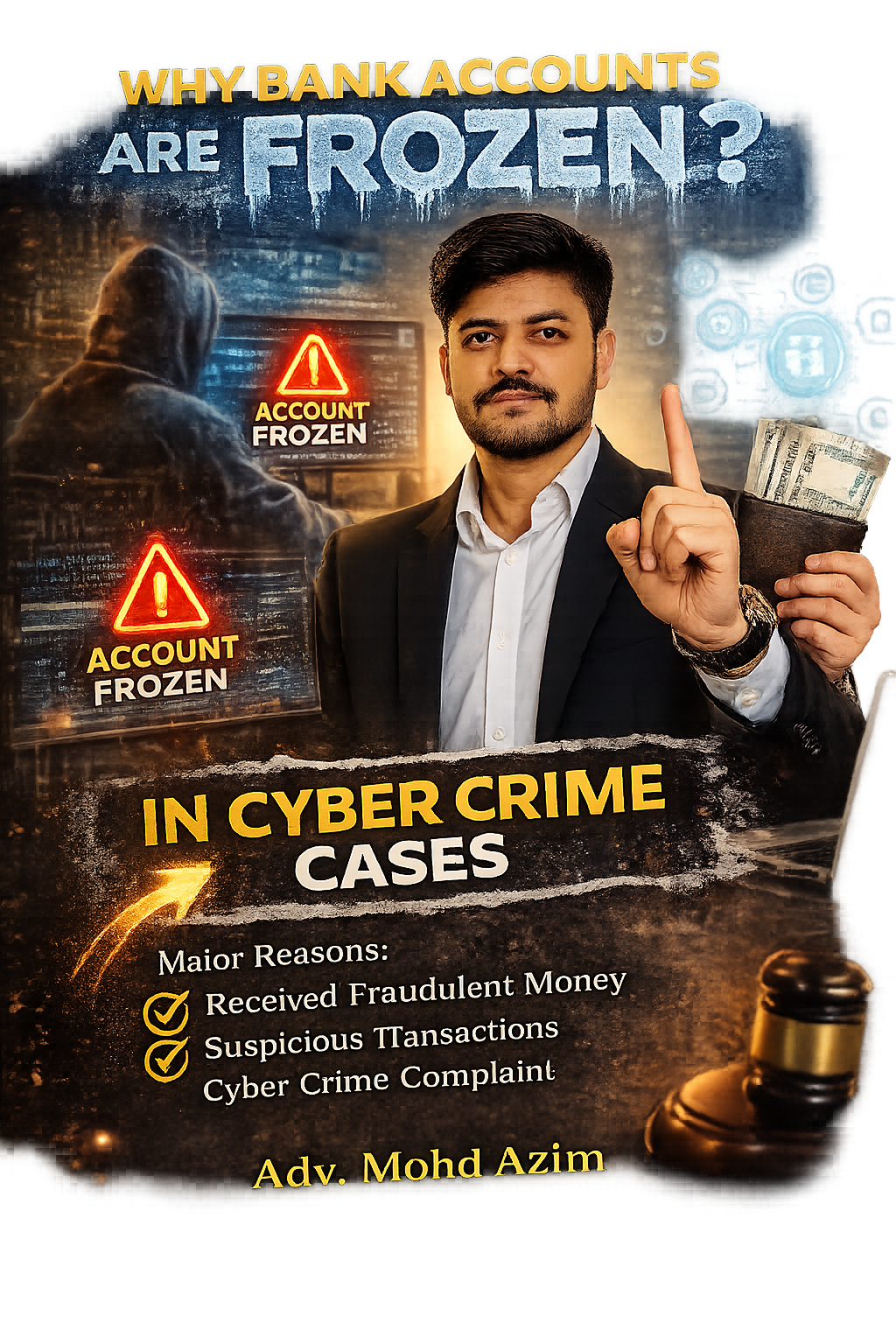
Waking up to find that your bank account has been frozen—unable to withdraw cash, transfer funds, pay EMIs, or even use your debit card—is one of the most stressful financial experiences a person can go through. In India, tens of thousands of bank accounts are frozen every year as part of cyber crime investigations. Many of these accounts belong not to criminals, but to ordinary individuals and small business owners who had no idea they were connected to a fraudulent transaction chain.
This article explains, in detail, the five most common reasons why bank accounts are frozen in cyber crime cases, what happens to your account after it is frozen, your legal rights during the investigation, and practical steps to protect yourself. If your account has been frozen or you believe it is at risk, understanding these reasons is the essential first step toward resolution.
How Bank Account Freezing Works in India
Bank account freezing is a legal measure that temporarily suspends all or selected operations on a bank account. When your account is frozen, you lose the ability to withdraw funds (ATM, branch, or online), make UPI or net banking transfers, use linked debit or credit cards for purchases, set up or honour standing instructions and EMI payments, and receive credits in some cases (depending on the type of freeze).
The freeze is not initiated by the bank on its own. Banks act upon a formal order or request from a law enforcement authority—typically the cyber crime police, Economic Offences Wing (EOW), a magistrate, or the Enforcement Directorate (ED). Under Section 102 of the Code of Criminal Procedure (CrPC)—now Section 106 of the Bharatiya Nagarik Suraksha Sanhita (BNSS)—police have the power to seize or freeze property that is suspected to be connected with a cognizable offence. The bank is legally obligated to comply with such orders and cannot independently decide to lift the freeze without clearance from the authority that imposed it.
There are two types of freezes: a complete freeze, where all transactions (both debit and credit) are blocked, and a partial freeze or lien, where a specific amount is held while the rest of the account remains operational. The type of freeze depends on the nature of the investigation and the amount under suspicion. Understanding which type of freeze applies to your account is important because it affects the legal strategy for resolution.
Reason 1 — Received Fraudulent Money (UPI Chain Transactions)
This is, by far, the most common reason innocent people find their bank accounts frozen. In a typical UPI fraud, the scammer tricks a victim into transferring money—through phishing, fake investment schemes, or impersonation. Once the money lands in the first account, the scammer quickly moves it through a chain of UPI IDs and bank accounts to make it harder to trace. These intermediary accounts often belong to people who have no knowledge of the fraud.
Here is how the chain typically works: The fraud victim transfers money to Account A (the scammer's or a mule account). Within minutes, the money moves from Account A to Account B, then to Account C, and sometimes to Account D, E, or beyond. Each of these accounts may belong to different individuals across different states. When the victim files a complaint with the cyber crime police or on the National Cyber Crime Reporting Portal (cybercrime.gov.in), the investigating authority traces the fund flow. Every account in the chain is flagged, and a freeze order is issued for each one.
If your account happened to receive a UPI payment from someone who received the fraudulent funds—even if you sold a legitimate product, received a repayment, or conducted a normal transaction—your account can be frozen. You may not have known that the money was tainted. This does not matter to the investigating authority at the initial stage. They freeze first and investigate later.
Reason 2 — Suspicious Transaction Patterns
Banks in India are required to monitor transaction patterns and report unusual activity to the Financial Intelligence Unit (FIU-IND) under the Prevention of Money Laundering Act, 2002. If your account exhibits patterns that deviate significantly from your normal transaction history or account profile, the bank may file a Suspicious Transaction Report (STR) or a Cash Transaction Report (CTR), which can trigger an investigation.
Transaction patterns that commonly attract scrutiny include:
- High-volume, rapid transfers: Receiving and immediately forwarding large sums through UPI, NEFT, or RTGS—especially to multiple accounts—resembles the pattern used by money mules in cyber fraud operations
- Transactions inconsistent with profile: If you are a salaried individual whose account suddenly shows receipts of lakhs from unknown sources, the mismatch raises flags. Business accounts are equally scrutinised if turnover patterns change dramatically without a corresponding business rationale
- Large cash deposits and withdrawals: Frequent deposits or withdrawals exceeding Rs 10 lakh in a financial year are reported to the FIU under the CTR regime. Structuring transactions just below this threshold—known as "smurfing"—also attracts attention
- Multiple accounts receiving and forwarding funds: Operating several accounts that collectively receive and disburse large sums can resemble a layering operation used in money laundering
- Dormant account suddenly active: An account that has been inactive for months or years and suddenly starts receiving and sending significant amounts is a classic red flag
If an STR leads to a police investigation, the investigating authority may request the bank to freeze the account while they verify the source and purpose of the suspicious transactions. In these cases, providing documentary evidence that the transactions were legitimate—such as invoices, contracts, sale deeds, or salary slips—is critical to resolving the freeze.
Reason 3 — Cyber Crime Complaint Filed Against You
Sometimes, a bank account is frozen not because it appeared in a transaction chain, but because someone filed a cyber crime complaint directly naming you or your account as the destination of fraudulent funds. This can happen when a genuine fraud victim identifies your UPI ID or account number from their transaction history, when someone files a malicious or mistaken complaint against you as a way to settle personal or commercial disputes, or when your phone number, email, or identity details were used by a fraudster (identity theft) to register a payment account in your name.
In cases where the complaint is genuine and your account is indeed the recipient of defrauded funds, the freeze is straightforward to understand—though it may still require legal intervention to resolve, especially if the funds were received for a legitimate purpose. In cases where the complaint is malicious or based on mistaken identity, the situation is more complex. You will need to present evidence that the complaint is unfounded, which may involve demonstrating that the transaction was lawful, that the complainant has a motive to make a false allegation, or that your identity was compromised.
- If a complaint was filed with the cyber police naming your account, you have the right to know the complaint details and the investigating officer
- Responding promptly with a well-drafted representation is essential—silence is often interpreted as an admission
- A lawyer experienced in cyber crime matters can help distinguish between a genuine complaint and one that is false or misdirected
Reason 4 — Payment Gateway or Business Disputes
Business owners and merchants who use payment gateways (Razorpay, PayU, CCAvenue, Cashfree, etc.) may find their bank accounts frozen as a result of disputes arising from their payment gateway activities. This typically happens when multiple customers file chargebacks or fraud complaints against a business, when the payment gateway itself identifies irregular transaction patterns and reports the merchant to the police or freezes settlement payouts, or when a customer files a cyber crime complaint alleging they were defrauded by the business.
Payment gateway-related freezes are increasingly common among e-commerce sellers, subscription-based businesses, and service providers. The freeze may affect the settlement account (where the gateway deposits funds), the business's primary operating account, or both. These cases are complex because they involve three parties—the customer, the payment gateway, and the merchant—each with their own documentation and perspective.
Resolving a payment gateway-related freeze requires presenting the gateway's transaction records, delivery confirmations, and customer communication logs to demonstrate that the business operated legitimately. In some cases, the dispute may also need to be resolved at the gateway level before the bank freeze can be lifted.
Reason 5 — Financial Investigation by ED or Police
The Enforcement Directorate (ED) has the power to attach and freeze bank accounts under the Prevention of Money Laundering Act (PMLA), 2002. ED investigations are distinct from regular cyber crime investigations and carry more severe consequences. The ED can provisionally attach any property—including bank accounts—that it believes are proceeds of crime or involved in money laundering. This provisional attachment is valid for 180 days and must be confirmed by the Adjudicating Authority.
ED-related freezes occur in cases involving large-scale financial fraud (hawala, Ponzi schemes, investment scams), cases where the predicate offence (the underlying crime) involves cyber fraud, money laundering allegations linked to crypto currency or online gambling platforms, and matters where funds have been transferred internationally. State-level financial crime branches and the EOW can also order account freezes during their investigations into economic offences. These investigations tend to be longer and more complex than standard cyber crime cases, and the legal strategy must account for the specific procedures and timelines of the PMLA or the relevant state laws.
What Happens After Your Account Is Frozen
Once your bank account is frozen, the immediate impact is financial disruption. EMI payments bounce, salary credits may be blocked or inaccessible, business operations halt, and personal expenses cannot be met. Beyond the immediate financial stress, the following process typically unfolds:
- Investigation proceeds: The investigating authority continues its inquiry into the complaint. They may call you for questioning, request documents, or take your statement. How you respond at this stage is critical
- Bank awaits clearance: The bank will not lift the freeze until it receives written clearance from the authority that imposed it. No amount of requests to the bank directly will change this
- Representation required: To get the freeze lifted, you (or your lawyer) must submit a formal representation to the investigating officer, explaining your position and providing supporting evidence
- Clearance or escalation: If the authority is satisfied, they issue a No Objection Certificate (NOC) or a letter directing the bank to lift the freeze. If they are not satisfied, or if the investigation is ongoing, you may need to approach the court for relief
The timeline for resolution varies widely. Straightforward UPI chain cases where the account holder can demonstrate innocence may be resolved in 2 to 6 weeks with proper legal representation. Complex cases involving ED or multiple complainants can take several months or longer.
Legal Rights of Account Holders During Investigation
Even when your account is frozen, you retain important legal rights that many people are unaware of. Understanding and asserting these rights can significantly impact the resolution of your case.
- Right to know the reason: You are entitled to know why your account was frozen, which authority ordered the freeze, and the reference number of the complaint or investigation. Your bank is required to provide this information
- Right to legal representation: You have the right to engage a lawyer and have them represent you before the investigating authority. You are not required to speak to the police without legal counsel
- Right against indefinite freeze: RBI guidelines and judicial precedents establish that accounts cannot remain frozen indefinitely without judicial review. If the freeze has been in place for an unreasonable period without progress in the investigation, you can challenge it in court
- Right to partial relief: In some cases, courts have directed that a portion of the frozen funds be released for meeting essential expenses—such as EMIs, medical bills, or business operational costs—while the investigation continues
- Right to file a representation: You have the right to submit a written representation to the investigating officer or the concerned authority, setting out your case and requesting relief
- Right to approach the court: If administrative remedies fail, you can file an application before the appropriate court—typically under Section 457 CrPC (return of property) or through a writ petition before the High Court
How to Protect Yourself from Unexpected Account Freezing
While it is impossible to eliminate the risk entirely—especially for UPI chain freezes where you may have no control—there are practical steps that significantly reduce the likelihood of your account being frozen.
- Know your transaction counterparties: Before accepting large UPI payments or bank transfers from unknown parties, verify the sender's identity. If you are selling goods or services online, maintain records of the buyer's details and the purpose of the transaction
- Maintain transaction records: Keep invoices, receipts, contracts, and communication logs for all significant transactions. If your account is ever flagged, these records are your primary defence
- Avoid lending your account: Never allow others to use your bank account or UPI ID for their transactions. Money mule operations frequently exploit people who agree to "pass through" funds in exchange for a commission
- Monitor your account regularly: Check your bank statements and transaction history frequently. If you notice unfamiliar credits, report them to your bank immediately rather than spending or forwarding the funds
- Keep your KYC updated: Ensure your bank account KYC is current and accurate. Outdated KYC can cause additional complications during an investigation
- Report suspicious activity promptly: If you receive unexpected funds from an unknown source, do not transfer them out. Contact your bank and the cyber crime helpline (1930) to report the matter before it escalates
Bank account freezing in cyber crime cases is a reality that affects a growing number of people in India. Whether your account was frozen because of UPI chain involvement, suspicious transaction patterns, a direct complaint, payment gateway disputes, or an ED investigation, the path to resolution requires understanding the reason, asserting your legal rights, and taking prompt, well-prepared legal action. For personalised guidance on your specific situation, book a consultation with Adv. Mohd Azim.